You can spend hours reading nursing notes, highlighting chapters, watching videos, and taking practice questions—then still freeze when a hard NCLEX question appears.
That is one of the most frustrating parts of nursing school.
You may know the material when you see it on the page. You may understand a rationale after you read it. But when a question asks you to connect symptoms, choose the priority action, or recognize what finding matters most, your mind can suddenly feel blank.
That does not always mean you did not study.
Sometimes, it means you need a better way to retrieve what you studied.
The NCLEX is not just a “Do you recognize this fact?” test. It asks you to notice important patient cues, connect the clues, decide what is most urgent, and choose the safest nursing action.
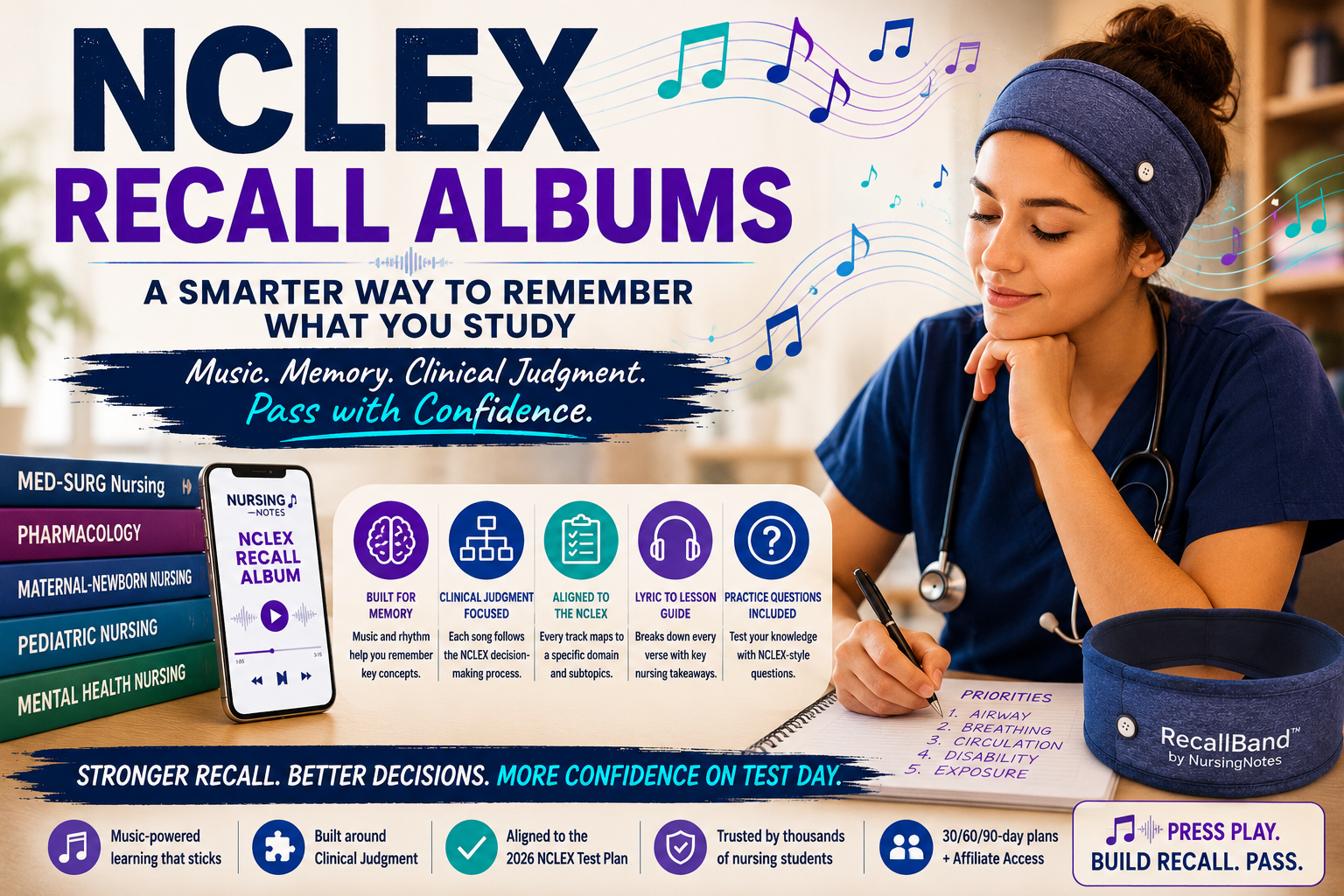
That is why NursingNotes created NCLEX Recall Albums.
Recall Albums are not random songs with nursing words added to a beat. They are carefully designed, topic-based learning albums that turn high-yield nursing concepts into repeatable recall cues.
Instead of only reading a fact once, you hear it through rhythm, repetition, patient stories, memorable hooks, and NCLEX-style thinking.
Old way: Read → highlight → forget → panic.
Rhythm way: Listen → repeat → connect → recall.
Before: The Problem With Traditional NCLEX Studying
Traditional NCLEX studying can become heavy fast.
You may have textbooks, class notes, flashcards, videos, question banks, study guides, care plans, and more tabs open than you can count. You may build a perfect study schedule on Sunday, then fall behind by Wednesday because life happens.
Classes happen. Clinicals happen. Work happens. Family happens. Exhaustion happens.
The issue is not that books, videos, or practice questions are bad. They are important tools.
The issue is that many students get stuck in a cycle of exposure without retrieval.
You reread a page and think, “I remember this.”
You watch a video and think, “That makes sense.”
You read a rationale and think, “I knew that.”
Then the NCLEX asks the same idea in a new patient situation, and suddenly it does not feel familiar anymore.
That is the trap.
Reading can make information look familiar. But familiar is not always the same as available.
On the NCLEX, you may need to remember what low urine output can mean, which medication finding should stop you from giving the dose, which patient needs attention first, or which assessment change points to worsening instability.
You do not have time to search through a textbook in your mind.
You need to recognize the cue, understand the risk, and move toward the safest answer.
That is where Recall Albums fit in.
They are built to help move key concepts from “I saw that before” to “I can pull that up when I need it.”
After: Imagine Studying That Fits Real Life
Imagine reviewing pharmacology while getting ready for class.
Imagine hearing safety concepts during your commute.
Imagine reinforcing respiratory warning signs while walking, folding laundry, or taking a break after clinical.
Imagine hearing the same high-yield lesson enough times that it becomes easier to recognize when a question tests it.
That is the purpose of NCLEX Recall Albums.
They help turn small pockets of time into meaningful review.
You do not have to wait for the perfect study setup. You do not need two quiet hours, a clean desk, full energy, and perfect motivation before you can review.
Recall Albums are designed for the real life of a nursing student.
They help you build more review reps without needing to add more hours to your day.
That does not mean you should stop taking practice questions.
It does not mean music replaces clinical judgment, rationales, or serious study.
It means you can add a stronger recall layer to the study tools you already use.
Practice questions show you what you know.
Rationales help you understand why.
NCLEX Recall Albums help give those lessons a rhythm you can repeat, revisit, and retrieve.
The Bridge: What Is an NCLEX Recall Album?
An NCLEX Recall Album is a group of music-based study tracks built around a major nursing topic.
Think of it as an organized audio study guide.
Each album focuses on an important area of NCLEX preparation. Depending on the album, topics may include:
- Medication safety and pharmacology
- Fluid, electrolytes, and acid-base balance
- Cardiovascular nursing
- Respiratory nursing
- Maternal and newborn care
- Pediatric nursing
- Mental health and psychosocial care
- Infection prevention and safety
- Delegation, prioritization, and management of care
- Clinical judgment and NCLEX decision-making
- Emergency and critical care concepts
Inside each album, individual tracks break large topics into smaller lessons.
For example, a medication safety album may include separate tracks about patient identification, allergies, lab review, contraindications, high-alert medications, when to hold a medication, therapeutic response, and patient teaching.
That matters because trying to force an entire textbook chapter into one song would be confusing.
Instead, each track focuses on one clear nursing decision, one important risk, or one high-yield idea that a student needs to recognize.
The goal is simple:
Turn key nursing concepts into recall cues you can access under pressure.
Every Track Starts With an NCLEX Learning Plan
A NursingNotes song is not written first and “made educational” later.
The learning design comes first.
Before a track is written, it is mapped to a specific NCLEX content area. Each song has a primary focus, and many tracks also have a secondary focus because real patient care rarely fits into one neat category.
For example, a song about fluid volume deficit may focus mainly on physiological adaptation while also reinforcing reduction of risk potential.
A song about holding a medication may focus mainly on pharmacological and parenteral therapies while also reinforcing safety and infection prevention.
A song about delegation may focus mainly on management of care while reinforcing priority-setting and patient safety.
This structure helps ensure that the music is not simply “about nursing.” It is built around the types of clinical thinking students need for NCLEX preparation.
Every track also has a focused learning objective.
A song may be designed to help you:
- Recognize worsening signs before a patient becomes unstable
- Know when to hold or question a medication
- Identify the highest-priority patient
- Connect abnormal findings to a possible patient problem
- Recognize dangerous lab changes
- Choose what the nurse should do first
- Evaluate whether an intervention worked
- Know what needs to be reported, reassessed, or escalated
The point is not to throw every fact into one verse.
The point is to teach one important decision well enough that it sticks.
Built Around Clinical Judgment, Not Just Memorization
The NCLEX does not only ask, “What fact did you memorize?”
It often asks whether you can look at a patient situation and think like a safe entry-level nurse.
That means noticing what matters, connecting the clues, deciding what is urgent, choosing an action, and checking whether the patient improved.
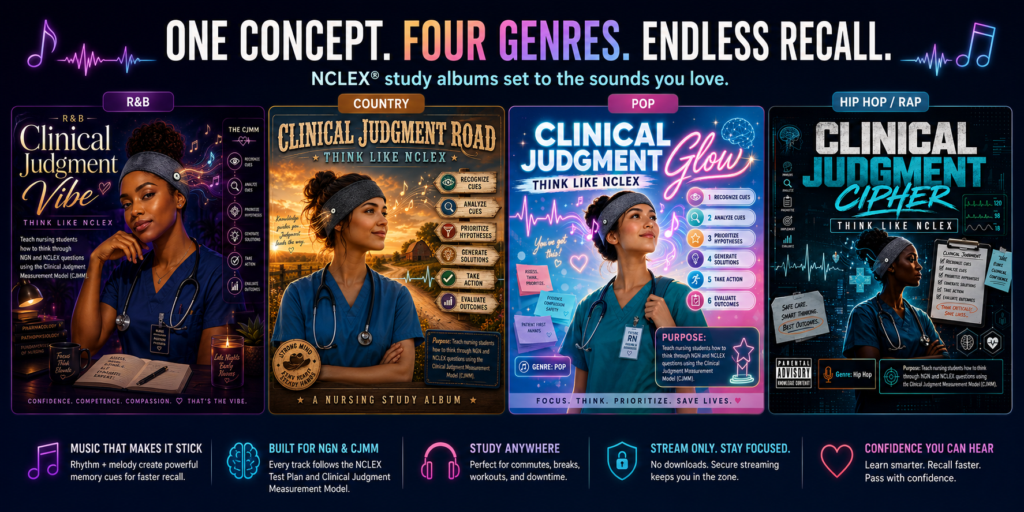
That is why every NursingNotes track is mapped to a Clinical Judgment Mini-Map.
The Mini-Map is based on the way clinical judgment works in NCLEX-style decision-making.
Each track is designed to reinforce the steps that matter most for that lesson:
Recognize Cues
What details should stand out?
This may include changes in vital signs, labs, mental status, pain, breathing, urine output, skin color, medication history, patient behavior, or new symptoms.
For example, a song about worsening fluid deficit may reinforce falling urine output, weak pulses, cool skin, tachycardia, or a dropping blood pressure.
Analyze Cues
What could those findings mean?
The lyrics connect the clues to a possible patient problem.
A student is not just told, “Low urine output is bad.” The lesson helps connect low urine output to poor renal perfusion, worsening fluid deficit, or shock risk.
Prioritize Hypotheses
What is the biggest risk right now?
This is where the song helps students separate a routine concern from an urgent one.
A patient who is uncomfortable but stable may not come before a patient with worsening breathing, poor perfusion, altered mental status, or signs of shock.
Generate Solutions
What nursing actions make sense?
The track may reinforce reassessment, monitoring, comparing trends, preparing to escalate care, reviewing orders, or addressing the highest-risk problem first.
Take Action
What should the nurse do now?
This step focuses on safe nursing action. It may include holding a medication, notifying the provider, reassessing the patient, using precautions, addressing airway concerns, or activating urgent support when appropriate.
Evaluate Outcomes
Did the action work?
The song may reinforce what improvement should look like, such as better oxygenation, improved urine output, stabilized vital signs, clearer mental status, less pain, or reduced signs of distress.
Not every song lists all six steps in order.
That would make the music sound like a lecture.
But every track is intentionally mapped to the clinical thinking behind the lesson. The goal is to help students build a repeatable habit:
Notice the cue. Understand the risk. Choose the priority. Take the safest action. Check the outcome.
The Song Structure Is Designed to Teach
A NursingNotes track is meant to be enjoyable enough to replay, but focused enough to teach.
The music is the delivery system. The lesson is built into the structure.
The Hook: The Recall Anchor
The hook is usually the most repeated part of the song.
It is designed to carry the main safety point, priority rule, or nursing action in a way that is easy to remember.
For example, a hook may reinforce:
- Stop and reassess when something does not match
- Hold the medication when the patient finding makes it unsafe
- Falling urine output can be a warning sign
- Airway and breathing come before comfort
- The correct answer is not always the highest-priority answer
The hook is not filler.
It is the recall anchor.
It gives students a short phrase, sound, or pattern that may come back to them later when they see a similar question.
The Verses: The Patient Story and Clinical Clues
The verses teach the details behind the hook.
They may describe a patient situation, highlight important findings, explain the risk, or show what could happen if the nurse misses a cue.
This helps the song move beyond simple memorization.
You are not only learning what to do.
You are learning what to notice and why it matters.
A song about medication safety might describe an allergy, abnormal lab, unsafe blood pressure, or missing assessment finding.
A song about respiratory decline might use patient symptoms, oxygen saturation changes, work of breathing, or altered mental status to help you picture the situation.
The verses create context.
Context makes the lesson more useful when an NCLEX question changes the wording.
The Bridge: The Safety Shift
The bridge is often where the song raises the stakes.
This is where the track may highlight the red flag, the worsening patient condition, the tempting wrong answer, or the danger of waiting too long.
The bridge helps students remember that not all findings carry the same urgency.
Some things can wait.
Some things cannot.
That is one of the hardest parts of NCLEX-style questions. Many answer choices may sound helpful, but the safest answer is usually the one that addresses the most urgent risk first.
The Spoken-Word Outro: Test Your Recall
Many NursingNotes tracks end with a spoken-word NCLEX-style question and answer.
This is where listening turns into active recall.
Instead of only hearing the lesson, you are asked to pull it back up.
The spoken outro may ask:
- Which finding is most concerning?
- What should the nurse do first?
- Which patient should be seen first?
- What medication finding should be reported?
- What outcome shows that the intervention worked?
These are original practice questions created to reinforce the lesson in the song. They are not real NCLEX questions.
The purpose is to help students pause, think, answer, and connect the question back to the recall cue they just heard.
That is important because learning is not only about hearing information.
It is also about practicing how to retrieve it.
Every Song Includes a Lyric-to-Lesson Guide
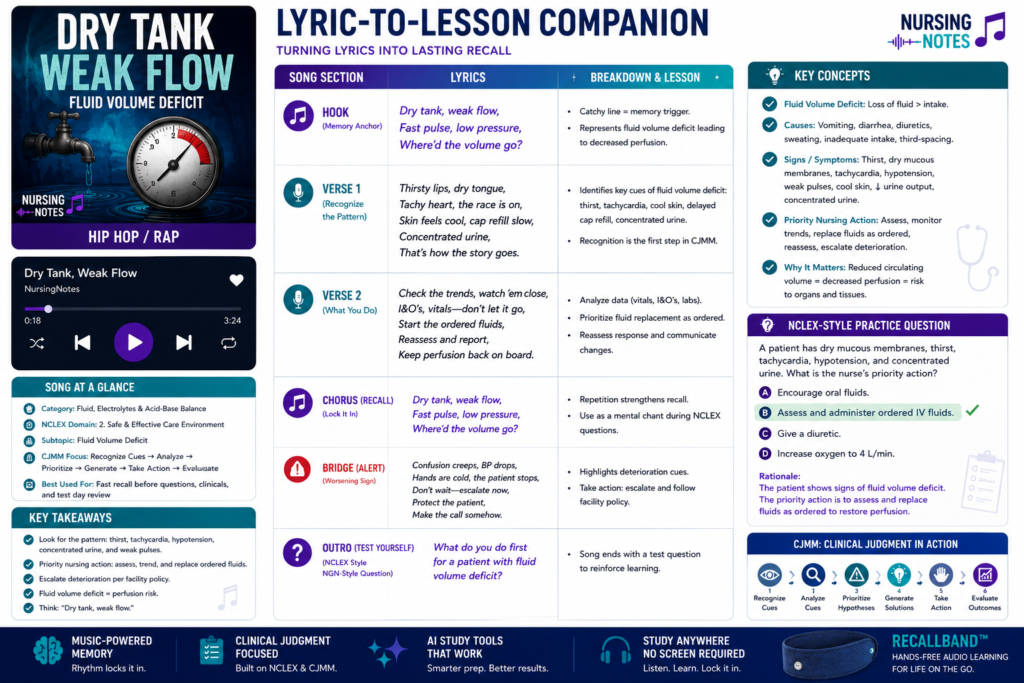
The learning does not end when the song ends.
Each NursingNotes track is paired with a Lyric-to-Lesson Guide.
The guide breaks the song down in clear nursing language so students understand what the music was teaching.
Depending on the track, the guide may include:
- The main learning objective
- The primary NCLEX content area
- The secondary content area, when relevant
- The key subtopics covered in the song
- The Clinical Judgment Mini-Map
- A breakdown of the verses
- An explanation of the hook and its recall cue
- Clinical pearls and red flags
- A practice question with the correct answer and explanation
This gives students two ways to learn the same concept.
First, they hear it through rhythm, story, and repetition.
Then, they review it in clear, direct nursing language.
That matters because NursingNotes is not asking students to choose between music and serious study.
The song gives the lesson a memorable shape.
The Lyric-to-Lesson Guide explains the clinical meaning behind it.
Together, they help turn a catchy phrase into a usable nursing concept.
Why Music and Repetition Can Help
Think about a song you have not heard in years.
You may not remember where you left your keys yesterday. But when the chorus starts, you may know every word.
Music can create strong memory cues because it combines rhythm, repetition, melody, emotion, and pattern.
NursingNotes uses those same tools with a clear educational purpose.
A repeated hook can become a quick reminder.
A patient story can make a concept easier to picture.
A rhythm can make a safety rule easier to revisit.
A spoken question can push you to retrieve what you just learned.
But let’s be honest about what music can and cannot do.
Music is not a shortcut around learning nursing.
You still need to understand the patient condition.
You still need to practice questions.
You still need to read rationales.
You still need to build clinical judgment.
Recall Albums are not designed to replace those things.
They are designed to make important lessons easier to repeat, easier to revisit, and easier to retrieve.
That is the difference.
How Recall Albums Fit Into a Smart NCLEX Study Plan
Recall Albums work best as part of a full study routine.
Here is a simple way to use them:
1. Start With Questions
Take a short set of questions in a weak area.
Maybe you keep missing medication safety questions. Maybe you struggle with fluids and electrolytes. Maybe prioritization questions keep getting you.
Your missed questions tell you where to focus.
2. Read the Rationale
Do not just look at the correct answer.
Ask yourself:
What cue did I miss?
Why was this answer safer than the others?
What patient finding changed the priority?
What would make this patient unstable?
This helps you understand the concept.
3. Listen to the Related Recall Album
Now use the track to reinforce the lesson.
You are not hearing a song at random. You are hearing it after seeing how the concept may show up in a question.
That makes the music more useful.
4. Review the Lyric-to-Lesson Guide
Read the guide after listening.
Look at the red flags, the hook explanation, the patient cues, and the practice question.
This is where you connect the music to the nursing decision.
5. Repeat It Later
Listen again during a low-effort moment.
During your commute.
While getting ready.
On a walk.
During chores.
Before clinical.
The goal is not to force a five-hour study session.
The goal is to keep the concept active long enough for it to become easier to retrieve.
6. Test Yourself Again
Come back to practice questions.
Can you recognize the cue faster?
Can you explain why one answer is more urgent?
Can you remember what to monitor, hold, report, or do first?
That is how listening becomes active learning.
Stop Rereading. Start Building Recall
You already know nursing school demands a lot from you.
You do not need more guilt.
You do not need another giant study guide you will barely finish.
You do not need a study method that only works when your life is quiet and perfect.
You need a system that helps you review smarter.
NCLEX Recall Albums are built for students who are tired of rereading the same material and hoping it sticks.
They are built for students who want high-yield concepts organized into repeatable tracks.
They are built for students who want to understand the lesson, hear it again later, and retrieve it faster when a question gets difficult.
You are not just listening to songs.
You are building recall cues around the clinical decisions the NCLEX expects you to make.
Practice questions test what you know. NursingNotes helps you remember it under pressure.
Choose the access plan that fits your timeline, press play, and start building recall that goes with you.