You may not have a studying problem.
You may have a study-time problem.
Nursing school is busy. NCLEX prep is busy. Your life is busy.
You have classes, clinicals, work, family, errands, assignments, laundry, meals, and very little energy left when the day is over. You may know you need to study, but finding a quiet desk, a full hour, and enough focus to read another chapter can feel almost impossible.
Then the guilt starts.
You tell yourself you should be reviewing more. You open your notes. You reread a few pages. You highlight something. You watch part of a video. Then you get distracted, tired, or pulled into something else.
The problem is not always that you do not care.
The problem is that most study tools only work when life slows down.
And life rarely slows down.
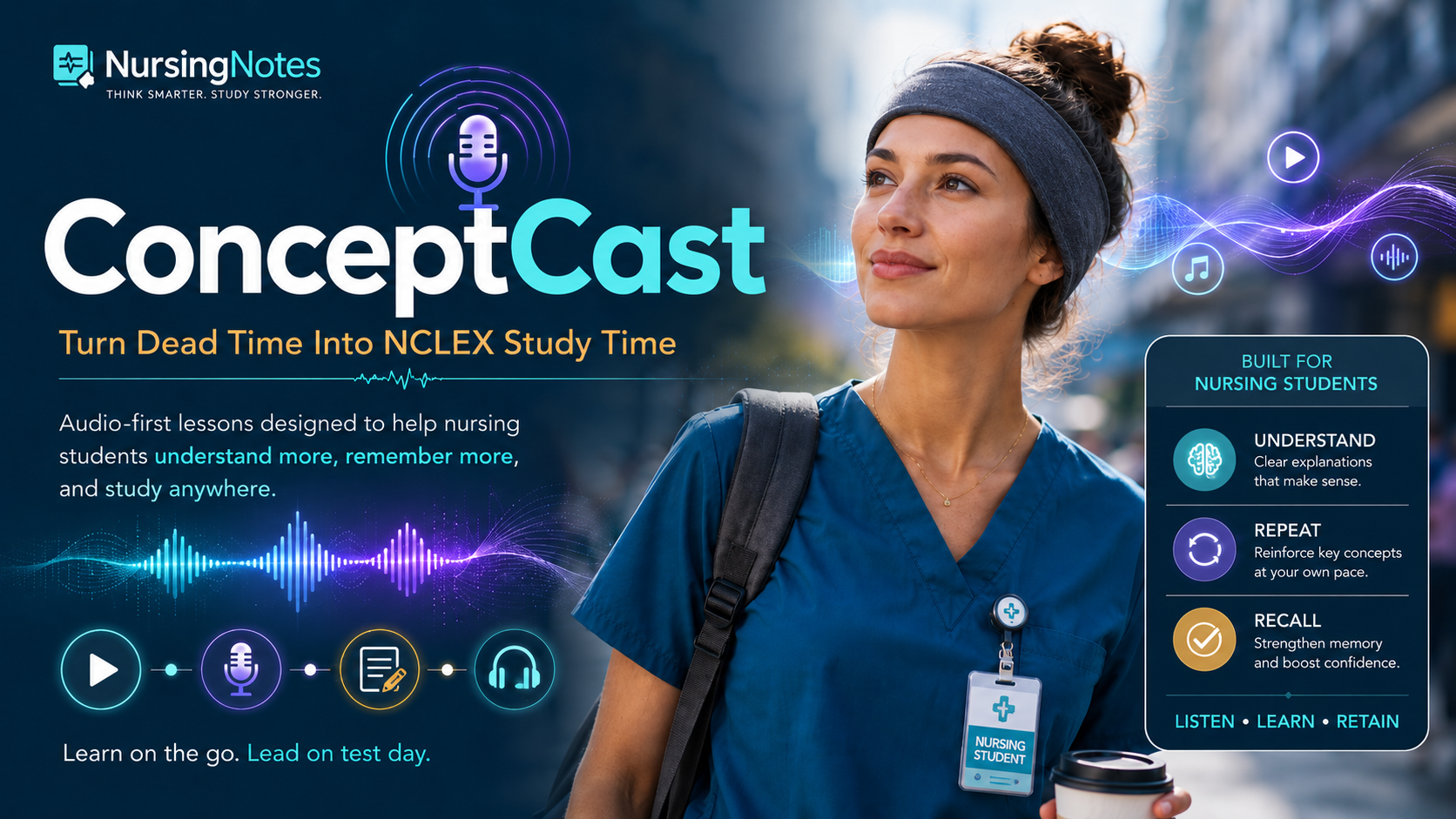
That is why NursingNotes created ConceptCast.
ConceptCast gives nursing students a way to learn high-yield NCLEX topics through short, focused, podcast-style audio lessons. You can listen while commuting, walking, getting ready, taking a break, doing chores, or winding down after clinical.
It is not background noise.
It is not a random nursing podcast.
It is a structured way to turn everyday moments into meaningful NCLEX review.
The Problem: Reading Is Not Always the Same as Learning
Reading is important. Textbooks matter. Notes matter. Practice questions matter.
But many students get trapped in a cycle that feels productive without always building strong recall.
You read a page and think, “I understand this.”
You watch a video and think, “That makes sense.”
You read a rationale and think, “I knew that.”
Then you see a new NCLEX-style question, and suddenly your mind goes blank.
Why?
Because recognizing information is not the same as being able to retrieve it.
The NCLEX does not ask whether you have seen a topic before.
It asks whether you can recognize patient cues, understand what those cues mean, decide what is most urgent, and choose the safest action.
That takes more than exposure.
It takes repetition, connection, and a study method you can actually use consistently.
The problem is that traditional studying often depends on perfect conditions.
You need a desk.
You need quiet.
You need enough time.
You need enough energy.
You need to be staring at a screen or a book.
That sounds reasonable until you remember that nursing students are not living in perfect conditions.
You are studying between shifts, before clinical, after class, during your commute, while doing laundry, while eating, or when you are too mentally tired to stare at another page.
That is exactly where ConceptCast fits.
When Studying Only Happens at a Desk, You Lose Too Many Hours
Think about how much time disappears every week.
Driving to school.
Walking to class.
Getting ready in the morning.
Folding laundry.
Cooking dinner.
Taking a break after clinical.
Going to the gym.
Cleaning your room.
Lying in bed trying to settle your mind after a long day.
Most students treat that time as “not study time.”
But it can become review time.
Not every minute needs to become intense studying. That would be unrealistic.
But many students have more usable time than they think. The issue is that their study tools are not built for those moments.
A 40-page chapter does not work while you are driving.
A long lecture video does not work while you are walking between classes.
A question bank does not always work while you are exhausted after clinical.
But a focused audio lesson can.
ConceptCast helps you use the time that usually gets lost.
Instead of waiting for the perfect study session, you can press play and review one important topic while life keeps moving.
That creates more repetitions.
More repetitions create more familiarity.
And when that familiarity is paired with active practice, rationales, Recall Albums, and NCLEX-style questions, it can become stronger recall.
The Solution: What Is ConceptCast?
ConceptCast is NursingNotes’ audio-first learning series for nursing students.
Each episode breaks down a high-yield nursing topic in a clear, focused, easy-to-follow format. Think of it like having a smart nursing tutor explain one important topic while you are on the move.
ConceptCast is built for students who want to understand difficult nursing concepts without needing to sit in front of a screen.
An episode may focus on topics such as:
- Pharmacology and medication safety
- Cardiovascular disorders
- Respiratory changes and warning signs
- Fluid and electrolyte balance
- Maternal and newborn care
- Pediatrics
- Mental health nursing
- Delegation and prioritization
- Infection prevention and safety
- Clinical judgment and NCLEX decision-making
- Emergency and critical care concepts
The goal is not to overload you with every detail from a textbook chapter.
The goal is to explain the parts that matter most.
ConceptCast helps you answer questions like:
- What is this condition or topic really about?
- What patient cues should stand out?
- Why is this finding dangerous?
- What is the nurse watching for?
- What action is most important?
- What mistake are students likely to make?
- What should I remember when I see this topic on a question?
That is what makes ConceptCast different from random audio content.
It is not made to fill time.
It is made to help you think through nursing content in a way that is easier to revisit.
ConceptCast Helps You Understand Before You Memorize
Memorizing facts without understanding them is fragile.
You may remember that a lab value is abnormal, but not know what it means for the patient.
You may remember that a symptom is concerning, but not know what action comes first.
You may know a medication side effect, but not understand whether you should monitor, hold the medication, notify the provider, or act immediately.
That is where ConceptCast helps.
ConceptCast gives you the “why” behind the fact.
For example, instead of only telling you that low urine output is a bad sign, a ConceptCast episode can help you understand why it matters.
Low urine output may mean the kidneys are not getting enough blood flow.
Poor blood flow may point to worsening perfusion.
Worsening perfusion can become a serious patient safety problem.
That chain matters.
When you understand the chain, you are less likely to panic when the NCLEX changes the wording of the question.
You start seeing the patient situation instead of memorizing one sentence.
That is how stronger clinical thinking begins.
Built for NCLEX-Style Thinking
The NCLEX is not just about memorizing lists.
It is about making safe decisions.
You may be asked to recognize important cues, connect those cues to a patient problem, choose what is most urgent, decide what action makes sense, and evaluate whether the patient improved.
ConceptCast is designed to support that kind of thinking.
A strong ConceptCast lesson may guide you through the same questions a safe nurse asks:
What am I seeing?
What findings are important?
What could this mean?
How do the signs connect to the patient’s problem?
What is the biggest risk?
What cannot wait?
What should the nurse do first?
What is the safest next step?
What outcome would show improvement?
What should change if the action worked?
This matters because many wrong answers on NCLEX-style questions are not completely wrong.
They may be helpful actions.
They may even be correct actions.
But they are not always the most important action right now.
ConceptCast helps students move beyond “What fact do I remember?” and toward “What does this patient need first?”
ConceptCast vs. NCLEX Recall Albums: Why You Need Both
ConceptCast and NCLEX Recall Albums work together, but they do different jobs.
ConceptCast helps you understand the topic.
It explains the patient problem, the key cues, the priority actions, and the clinical reasoning behind the lesson.
Recall Albums help you remember the topic.
They use rhythm, repetition, hooks, stories, and music-based recall cues to help key ideas stay available when you need them again.
Think of it this way:
ConceptCast gives you the lesson.
Recall Albums give you the memory hook.
Practice questions show you whether you can apply it.
That is a much stronger study loop than rereading alone.
You can listen to a ConceptCast episode about fluid volume deficit to understand the warning signs and priorities.
Then you can listen to a Recall Album track that reinforces cues like falling urine output, weak pulses, cool skin, tachycardia, and dropping blood pressure.
Then you can take practice questions to see whether you can spot the problem in a new patient scenario.
That is not passive listening.
That is a complete learning loop.
Why Audio Learning Fits Nursing Students
Audio is not a replacement for active study.
It is a way to make studying easier to return to.
That matters because consistency beats occasional marathon sessions.
A student who studies for six hours one weekend and then disappears for four days may feel productive, but may not build steady recall.
A student who reviews one high-yield topic every day has more chances to keep the material active.
ConceptCast helps make that possible.
Audio learning can fit into the small spaces of your day.
You can listen:
- During your commute
- While getting ready for class
- Before clinical
- During a walk
- While folding laundry
- At the gym
- During a break
- After clinical
- Before bed
- While using FocusBand for hands-free audio learning
You do not need to stare at another screen.
You do not need to wait for the perfect study session.
You just need to press play and stay engaged with the lesson.
The Best Way to Use ConceptCast
ConceptCast works best when you use it with intention.
Do not just play an episode while scrolling social media or doing something that needs your full attention.
Instead, use this simple system:
1. Pick One Weak Topic
Start with an area that keeps showing up in missed questions.
Maybe you struggle with medication safety.
Maybe you keep missing prioritization questions.
Maybe fluids, respiratory topics, maternity, or mental health questions are your weak points.
Your missed questions are clues. Let them tell you where to focus.
2. Listen to the Matching ConceptCast Episode
Listen once without trying to memorize every word.
Focus on the main idea.
Ask yourself:
What is the patient risk?
What cues matter most?
What action comes first?
What would make this patient unstable?
3. Repeat the Main Lesson Out Loud
After the episode, summarize the topic in your own words.
For example:
“Low urine output can mean poor perfusion. I need to watch the trend, assess the patient, and recognize worsening shock signs.”
You do not need perfect wording.
You need to prove that you understand the concept.
4. Reinforce It With a Recall Album
Next, listen to the related NursingNotes Recall Album track.
This is where the concept gets a rhythm, hook, story, or repeated phrase that is easier to revisit later.
5. Test Yourself With Questions
Take practice questions on the same topic.
Can you recognize the cue faster?
Can you explain why one answer is safer than the others?
Can you identify what matters most?
That is how you turn listening into usable recall.
What ConceptCast Will Not Do
Let’s be clear.
ConceptCast will not replace nursing school.
It will not replace your instructors.
It will not replace practice questions.
It will not replace rationales, clinical experience, or serious study.
Anyone promising that one audio lesson will make you ready for the NCLEX is selling fantasy.
ConceptCast is valuable because it makes high-yield review easier to fit into real life.
It helps you understand difficult concepts in a more portable way.
It helps you use time that would otherwise be lost.
It helps you build more repetitions without forcing you to spend every extra moment staring at a screen.
And when you pair it with Recall Albums, practice questions, rationales, and case studies, it becomes part of a smarter study system.
Stop Waiting for More Time. Use the Time You Already Have.
You may not need a perfect schedule.
You may not need another stack of notes.
You may not need to study harder.
You may need a study system that works when your life is messy, busy, loud, and unpredictable.
ConceptCast is built for that.
It helps you turn dead time into NCLEX review.
It helps you understand the lesson before you try to memorize it.
It helps you keep high-yield concepts active even when you are away from your desk.
And it helps you build the kind of recall you need when the question is new, the answer choices are close, and the pressure is real.
Listen to understand. Repeat to remember. Practice to apply.
That is the ConceptCast advantage.
Start with one topic, press play, and make your next commute, walk, or study break count.